
Finding Households by Nevada Street
A street search works best when each step keeps the address tied to a parcel, an office, and a source date. Nevada does not have one statewide owner-and-address portal. Start in the county that holds the land record. In Clark County, the assessor can resolve a site address to an assessment parcel, and the recorder can then be searched for instruments tied to that parcel or its owner. A deed shows a recorded transfer; it does not say who slept in the home. Use later household records only for the question they can answer, and keep the current-owner trail apart from evidence about past occupants.
- Keep the original street number, direction, name, type, unit, postal city, and ZIP as written. Normalize a second copy for searching, but do not discard the source form.
- Search the county assessor by site address, then record the APN, legal description, jurisdiction, and the form options used.
- Open the county parcel viewer and check its parcel links, map date, and legal description before treating a nearby parcel as part of the same property.
- Search the recorder by parcel, name, instrument number, or legal description. Save the grantor, grantee, document type, and recording date for each deed in the chain.
- If voter information fits the question, use the DMV/SOS status route or ask the county elections office what dated list product may be released. Protected fields stay private; a voter file is not a resident roster.
- For an older household clue, check a dated city or reverse (criss-cross) directory if the library holds one. Record its year and page; a listing is not proof that every named person lived at the address.
Clark County Street Search Fields
The Clark County Assessor form separates street components. Street Name is required; Street Number is numeric. Legal City/Town follows a boundary, not necessarily the mailing city. Phonetic matching and the current-parcel or present/prior-owner choice are additional options; preserve each selection because a current-only mode may miss an earlier owner.
| Form label | Input | Required | What to keep |
|---|---|---|---|
| Street Number | Numeric | No requirement stated | Number searched and any unit retained separately |
| Street Direction | Dropdown | No requirement stated | Selected prefix or suffix direction |
| Street Name | Required search field | Required | Spelling entered, including a variant if tested |
| Street Type | Dropdown | No requirement stated | Selected type, such as the listed street suffix |
| City/Town | Dropdown | No requirement stated | Legal-boundary choice, not just postal city |
| Phonetic match | Optional search control | No requirement stated | Whether phonetic matching was selected |
| Current/prior owner preference | Selection | No requirement stated | Current parcel or present/prior owners option |
Before searching, the official Clark address form shows the separate street controls and owner-history preference used for this Nevada street directory.
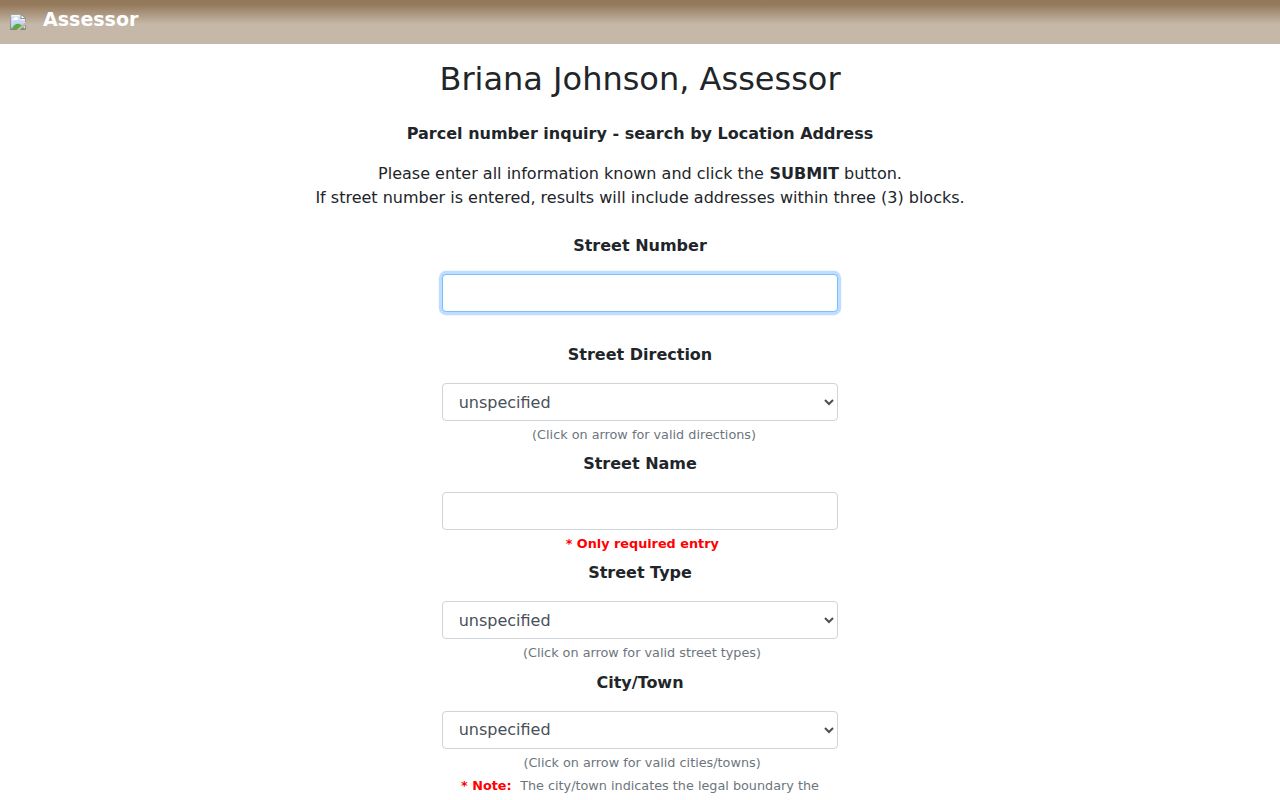
The form states that a street-number search can return addresses within three blocks. Check each result against its parcel location and legal description before connecting it to the original address.
Nevada Parcels Along the Street
Clark GISMO/OpenWeb adds map context to an assessor result. The sampled parcel view can show APN, owner, site address, jurisdiction, sale date and price, estimated lot size, construction year, recorded-document number, aerial date, and legal description. It also lists tax district and census tract, with links to assessor data, parcel maps, the Treasurer, document images, the Recorder, and other maps. These fields are leads back to the custodian. The viewer warns that estimates need to be checked against official records, so estimated sale value is not the assessed value or necessarily the amount paid.
For the next lot, use map browse or a measurement tool, click the parcel, and save its APN and legal description as a separate record. GISMO can explain how a street is divided into lots, but physical closeness does not prove shared ownership, residence, or a family link. Note the viewer’s aerial and source dates. That caution is central to a Nevada street directory: map proximity should lead to another record, not an identity claim.
When the statewide layer is more convenient, the Nevada DOT Statewide Parcels service can help discover a county source. Its parcel reference is dated 2018, and county data is supplied by local offices. Follow its county or website link to the live assessor record before relying on an owner or address field.
Note: A map gives location context; the assessor and recorder remain the better sources for current assessment fields and recorded instruments.
Nevada Records by Street
Address records answer different questions; they do not produce one roster. Nevada assessor and recorder systems are county-specific. Clark has the most connected online property tools in the research, while other counties may require an office or archive request.
| Record | Keeper | What it can show | Access route |
|---|---|---|---|
| Assessment parcel | County assessor | APN, owner for assessment, site and mailing addresses, legal description, and assessment details where offered | County portal or assessor office; Clark has a site-address form |
| Parcel map | County GIS or assessor | Parcel shape, jurisdiction, linked fields, and map context | Local viewer; Nevada DOT 2018 layer is a discovery aid |
| Recorded instrument | County recorder | Named parties, document type, recording reference, parcel or legal description, and image if available | County index, office, or historical microfilm where offered |
| Voter-file product | County clerk/elections office | Only fields the office may release under election law and the product’s date | County request route; no verified statewide browse-by-name page |
| Address assignment or change | City or county department | Existing assignment, street-name, annexation, or subdivision record if held | Ask the local custodian by APN, old and new number, or legal description |
Do not assume the same search depth in each county. The Nevada Recorders Association routes researchers to recorder offices, not a statewide deed index. When no online index fits, ask the county office for its request route and any release limits. Under the Nevada Public Records Act, agencies respond by the end of the fifth business day; fees generally reflect actual costs.
Nevada Situs and Mailing Addresses
The Clark Assessor glossary separates the location address from the mailing address. The location, or situs, address is used to find the parcel; the mailing address is where tax bills go and may be somewhere else. Owner names are kept for assessment and tax billing, come from recorded documents, and are limited to two lines. “ETAL” can stand for more owners. An owner line and mail destination do not prove who lives at the parcel.
Keep the original and normalized address, postal city and ZIP, legal city or town, APN, legal description, mailing address, and source date side by side. Nevada’s postal geography and municipal boundaries do not always line up. The Clark Assessor glossary says the County Building Department assigns addresses in unincorporated areas; cities assign addresses within their own boundaries.
- APN
- An assessor parcel number used to identify a land parcel in assessment and map records.
- Parcel
- A defined tract of land carried as one unit in assessor and map records.
- Situs address
- The location address used to place a parcel, distinct from where tax mail is sent.
- Plat
- A recorded or mapped plan that lays out lots, streets, or subdivisions.
- Legal description
- The parcel’s description by subdivision, lot and block, survey, or other land terms; older instruments may use it instead of today’s street number.
- Criss-cross directory
- A reverse directory section, when held, that lets a researcher start from a street address and look for a listed name.
For a family tracing a sale or inheritance, separate labels can connect an old deed to a current map without implying that the owner lived at the site.
Tracing a Nevada Street Deed Chain
Clark Recorder Acclaim has Simple Search, Name, Parcel Number, Instrument Number, Document Type, Book/Page, Record Date, Total Value, and Legal Description modes. The Name screen takes a last name and first or company name, supports starts-with, contains, and exact matches, and can narrow by book type, date span, displayed names, and document type. A name hit is not yet a deed chain. Capture the instrument number, recording date, parties, document type, APN or legal description, book/page, and image availability.
The Clark Recorder Name search is useful after the assessor has supplied an owner name or parcel reference. Search by parcel or legal description when names change or are spelled in more than one way. Read the index entry and image together if both are offered; the index is a path to the instrument, not a substitute for its wording.
Open the official name-search screen to inspect the match, date, book, and document-type controls used to test parties in Clark County.
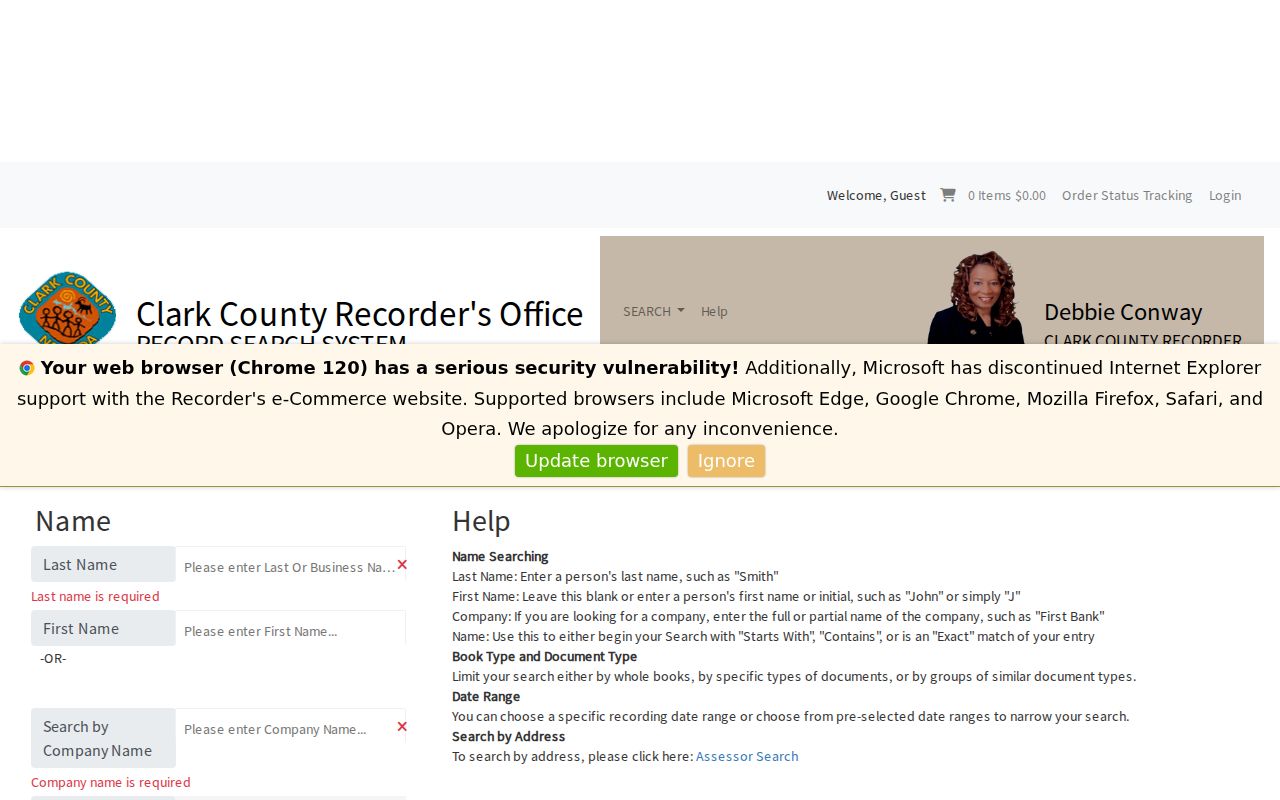
Those controls can narrow a parcel’s recorded trail, but the current online cutoff was not established in the research and should not be guessed.
In the chain, a grantor transfers an interest and a grantee receives one. Deeds, trust deeds, mortgages, assignments, releases, liens, judgments, maps, and other instruments have different roles. Compare the legal description and APN across records. The assessor says more than 90 percent of Clark parcels had new APNs by December 1996, so an old and new number may both matter. A number change alone does not prove a sale.
Voter Records on Nevada Streets
Voter information has a separate custody and privacy line. Under Nevada election rules, the county clerk keeps registration books and related documents. Some voter-list information may be public, but a voter’s registration location is confidential; Social Security number, driver-license or ID number, and registration email are not ordinary public fields. A voter may request address or phone withholding through the statutory process. Do not treat a public voter file as a street-by-street resident list or republish protected fields.
The Nevada DMV voter page routes a person to the Secretary of State’s status or update service, which uses a Nevada driver license or ID. The research did not expose a stable statewide browse-by-name status page. For any public list or list-maintenance record, contact the county elections office and ask what product may be released, its date, file format, fee, and protected-field handling. Keep the answer with the request. Campaign filings, precinct maps, results, and meeting records can show civic activity without establishing a home address.
Note: A blank or suppressed voter field is not evidence that a person has no Nevada residence or no registration record.
Nevada Addresses Cross City Lines
A Nevada street can carry a postal city name that differs from the city or county responsible for the land record. Across the Las Vegas Valley, a mailing city does not settle jurisdiction. The Clark Assessor’s City/Town selector follows legal boundaries; its glossary says the County Building Department assigns addresses in unincorporated areas while cities assign them within city limits. Rural Nevada can add a route, town, and county layer, so identify the parcel’s jurisdiction before asking an office for a record it may not hold.
When the street name or number seems wrong, ask the appropriate city or county custodian for an existing address assignment, street-name change, annexation, or subdivision record. Include the current APN and legal description, then supply the old number or name as a search term. Nevada research did not locate a statewide street-renaming or address-history index. A negative result in one portal therefore describes that search, not every historical record in the county.
This geographic check is useful for a person rebuilding a family property history: it helps route the next question to the office that handled the place at the time, without assuming current boundaries always applied.
Nevada Street Directories in Context
Modern assessor and recorder tools are strongest for parcels and recorded ownership. Older household evidence comes from dated city directories, street sections, newspapers, maps, and archives, where available. UNR’s digital collections describe early Reno, Sparks, and surrounding-area directory material beginning around 1900. The UNLV microform catalog describes Nevada Territory directories from 1861 to 1882. A directory is a year-specific snapshot, and missing entries or gaps between editions do not prove a household left on a particular date.
The city-directory collection page covers those historical runs and how to read them. For one person whose identity needs to be checked across several sources, continue with the Nevada resident lookup workflow rather than treating a street-wide search as proof of identity.
Keep the publisher, year, city, page, street spelling, and image or reel reference for each listing. Search the address in more than one form. The access paths and year details belong with the Nevada city directory collections.
Limits of a Nevada Street Directory
A parcel record names an assessment owner and a deed records parties to a transfer; neither proves who lives at the address. Adjacent parcels do not prove a household relationship, and permits may name an applicant or contractor. Directory entries vary by year and use. Nevada voter, court, and vital records follow separate release rules.
Use each record for personal research, property history, family history, or civic understanding. Verify a legal or title question with the office that keeps the record, and leave out sensitive fields that are not needed to answer it.
Privacy. Do not use a street search to track, expose, or harass a person. Respect address suppression and other confidentiality limits, even when nearby records are public.