
Nevada Previous Residents by Era
Previous residents leave different traces at different dates. A recorder index follows a legal instrument, while a directory records a dated listing and a Sanborn sheet describes a building and lot. Nevada’s county systems do not share one online cutoff. The clearest historical example in the research is Douglas County; Clark’s current recorder search is useful, but its online cutoff was not confirmed.
| Source | Known years | Where held | What it can show |
|---|---|---|---|
| Clark Recorder Acclaim | Online cutoff not established | Clark County Recorder portal | Indexed instruments and images where offered |
| Douglas County Recorder | Digital index/images, 1960-1972; deed, Kinsey, and patent material, 1855-1959 | County recorder; older material onsite on microfilm or microfiche | Recorded land instruments and older index routes |
| UNR directory collections | Early runs begin around 1900 | UNR Digital Special Collections | Dated Reno, Sparks, and nearby listings |
| UNLV territorial directories | 1861-1882 | Library microform catalog and reels | Residents, occupations, street sections, firms, and organizations as printed |
| Reno Sanborn maps | 1918 through December 1949, 73 sheets | Library of Congress collection | Building footprints, use, materials, lots, roads, and revisions |
| Nevada newspapers | Review-Journal index, 1930-1968; Las Vegas Age index, 1905-1940 | UNLV microfilm and index resources | Obituaries, probate and property notices, and local events |
Start with the source nearest the date in question, then test it against another source type. The official year ranges are specific to these collections; they should not be carried over to another Nevada county.
Nevada Recorder Records by Type
Clark Recorder Acclaim separates its index into Simple Search, Name, Parcel Number, Instrument Number, Document Type, Book/Page, Record Date, Total Value, and Legal Description modes. The document-type screen can narrow by kind of instrument and date. That can help test whether a known deed belongs in the chain or whether a release or other follow-up instrument appears nearby. The full current document-type vocabulary was not captured, so do not assume the visible categories are complete.
Use the Clark County Recorder document-type search after you have a parcel, name, date span, or recording reference to test. The index may lead to an image, but the exact online cutoff was not established. If the portal stops before the period needed, ask the Recorder about the relevant index, book, microfilm, or in-person route instead of treating an empty online search as proof that no deed exists.
The official search screen exposes the document category and date-range controls used to narrow an instrument search.
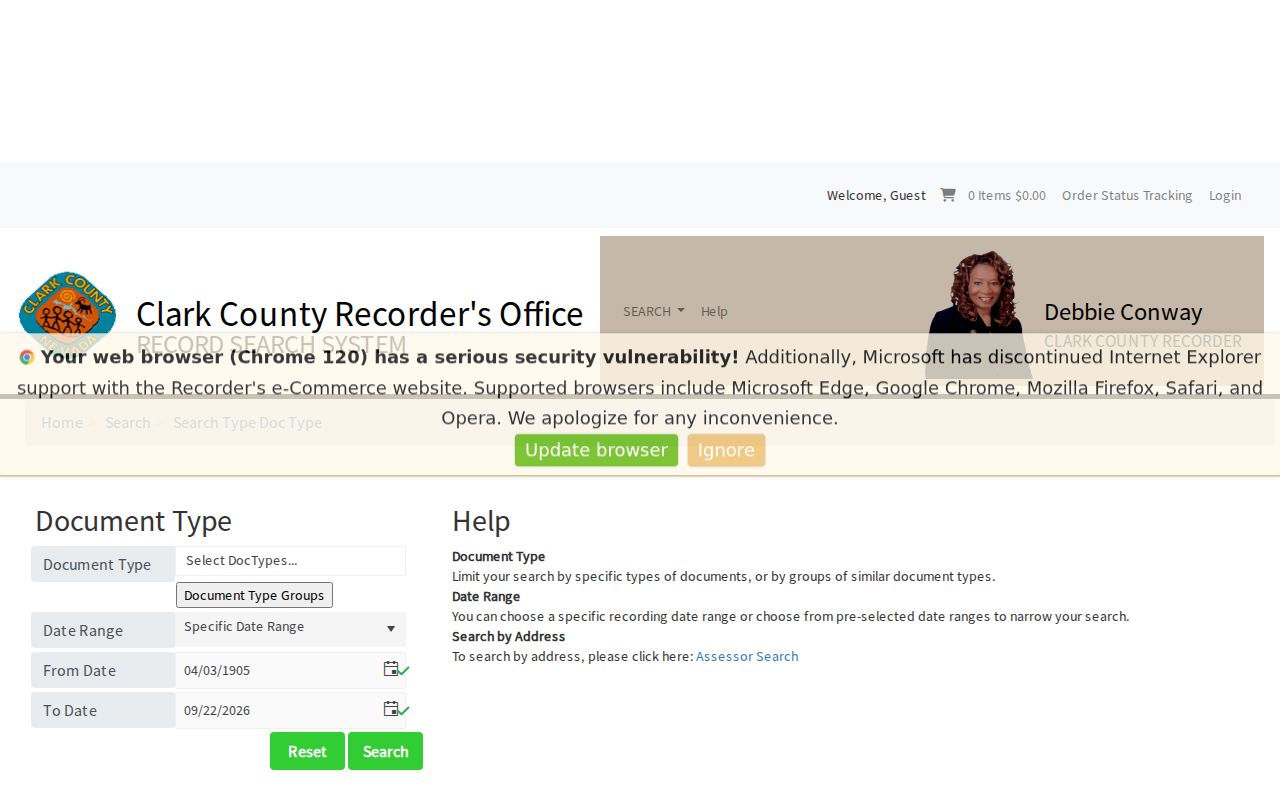
Capture the search type and date filters with each result so another researcher can tell what the portal did and did not cover.
Nevada Records in Douglas County
Douglas County offers a useful example of how one Nevada recorder can keep distinct digital and onsite layers. Its official historical search describes digital indexes and images for 1960 through 1972, plus deed, Kinsey, and patent material from 1855 through 1959. Older historic records are available onsite on microfilm or microfiche. These ranges belong to Douglas County and should not be applied to Clark, Washoe, or a statewide deed search.
Use the Douglas County Recorder historical search to see the county’s stated routes. For an older Lake Tahoe area property, preserve the county, date, record type, name or land description, and the search route. If the online path does not cover the period, ask the recorder what onsite index or image set matches the record. A counter or microfilm search can succeed where an online name query does not.
Nevada Deed Records for Past Owners
A chain of title is the sequence of recorded transfers and related instruments tied to a parcel. In Clark County, begin with the assessor’s parcel record and legal description, then use the recorder index to identify the current or most recent deed. Read backward from the grantee to the prior grantor, checking that the land description still matches. An index hit is a lead; inspect the image or ask the recorder for the instrument when the wording matters. Keep recording date separate from any effective or execution date printed on a document.
- Write down the current APN, site address, legal description, and jurisdiction from the county assessor.
- Search the recorder by owner name, parcel, instrument number, or legal description. Preserve the exact filter and date span.
- Open the deed image if available. Note instrument number, recording date, document type, parties, book/page, APN, and legal description.
- Use the prior grantee or grantor and the land description to locate the earlier deed. Compare each instrument before adding it to the chain.
- When the online years end, ask the county recorder for the older index or onsite book, film, or fiche route.
- Grantor and grantee
- The grantor is the party shown as transferring an interest; the grantee is the party receiving it.
- Chain of title
- The linked record of transfers and other title instruments for a parcel over time.
- Legal description
- The land description in an instrument, such as a subdivision, lot and block, survey, or other parcel terms.
The current parcel-to-assessor sequence is set out in the Nevada street directory; this backward search begins where that present-day chain ends.
Old APNs and Nevada Street Numbers
A current parcel number may not be the one printed in an older deed. The Clark Assessor glossary describes old APNs in a three-three-three pattern and newer APNs in a three-two-three-three pattern. The newer number is geographic, and more than 90 percent of Clark parcels had received new numbers by December 1996. A changed APN does not change the legal description and does not by itself prove a transfer. Search the prior and current numbers together when the record date crosses that change.
Street numbers and names can shift too. Nevada research did not locate a statewide address-history or street-renaming index. A deed may use an earlier street number, a subdivision lot, a town lot, a mining claim, or a metes-and-bounds description instead. Keep the address as printed, then compare it with the current parcel’s legal description and map. If the chain stops, ask the local address-assignment, recorder, or archive custodian for existing records keyed to both the old and current terms.
For a family member following a parcel through a move or inheritance, this bridge can prevent a false break in the record trail when the land is the same but its address label has changed.
Nevada Directories Meet Census Years
Directories can supply dated household clues where a deed only names the parties to a transfer. UNR Digital Special Collections describes early directories for Reno, Sparks, and nearby areas beginning around 1900. The UNLV microform catalog identifies Nevada Territory runs from 1861 to 1882 and says the volumes may include residents, occupations, heads of families, street sections, organizations, and businesses. Each volume has its own title, publisher, and arrangement. Read the front matter and abbreviation key before comparing entries across years.
To pair a directory with census evidence, use the dates as a comparison plan rather than assuming both sources give a full address list:
- Write down the exact directory year, city or area, page, name spelling, street form, and publisher.
- Find an available census record from a nearby census year for the same place, then compare names and household details that the record actually provides.
- Check another directory year or an independent source before assigning a move date. The research did not inventory Nevada census schedules or their local access routes, so availability must be confirmed with the holding library or archive.
The Nevada city directory collections entry explains the holdings and how to read a listing. In an address trail, a directory is one dated tool, not proof that each person named owned or remained in the home.
Nevada Records in Former Counties
Nevada land history predates today’s county map. State Library and Archives finding aids describe Carson County and Utah-Nevada territorial records from 1851 to 1864, along with local record series for Storey, Washoe, Lyon, Douglas, and Ormsby. A deed, claim, court record, or probate file may be grouped by the county or territorial office that existed at the time, not by the present-day county name.
When an older Nevada street search fails, test the place and date before repeating the same name query. Ask which jurisdiction held the parcel then, and whether the record may be filed under a mining district, townsite, claim, company, or lot description. The Nevada State Library archival collections guide can help identify record series. A finding aid points to material; it does not promise every item is indexed, digitized, open, or about a named person.
Nevada Sanborn Records of Buildings
The Library of Congress identifies 73 Reno Sanborn sheets covering 1918 through December 1949. They map building footprints, construction material, height, use, lot lines, roads, water features, and later corrections. That can help explain whether a structure or lot existed in a given period, or why an old house number does not line up neatly with the modern parcel.
Use the Library of Congress Reno Sanborn item to identify the city, edition, date, sheet, street crossing, building label, and map index. Then compare the lot or subdivision with the assessor’s legal description. A Sanborn map is evidence about a building and its surroundings. It does not name each resident, and its use label should not be mistaken for a household listing.
Nevada Newspaper Records and Probate
Newspaper notices can extend a house history after a person leaves an address. UNLV’s Nevada Newspapers on Microfilm page reports holdings from more than 800 newspaper titles by place and identifies indexes for the Review-Journal from 1930 to 1968 and the Las Vegas Age from 1905 to 1940. Search an obituary, probate notice, marriage item, property notice, or community event as a lead, then note the paper, date, page, headline, and type of notice. A newspaper mention is not a certified civil record.
The UNLV newspaper collection page routes readers to holdings and local access points. The Las Vegas-Clark County Library District genealogy resources link to newspaper and local-history material. FamilySearch Nevada Wills and Deeds and its Nevada County Marriages collection can help discover a record, but image access and coverage vary. Confirm an index lead with the county or archive that holds the original.
For probate, deeds, or a legal notice, match more than a name: use the event date, parcel description, instrument number, place, or another independent detail. That helps avoid merging two people with similar names into one history.
Nevada Previous Residents and Privacy
Property, directory, map, and newspaper records leave different kinds of evidence. A recorder can show an instrument between named parties. An assessor can show the owner used for tax purposes. A directory may list a person or household at a date, and a map can show the building on the lot. None of these alone proves that every person named lived there throughout the year. Compare dates and record types, and keep a note when the source is an index, image, scan, or finding aid.
Personal house history, family research, and local history are useful reasons to follow a past address. Research on previous residents should leave out unnecessary personal details and respect restricted records or a protected address. A non-result can reflect an online index gap or a different historical jurisdiction.
Lawful use. Keep a Nevada address search to personal, family, property, or civic research. Do not use the results to stalk, expose, or harass a living person.