
Nevada Resident Lookup: What Each Record Shows
Nevada has no statewide directory that proves a person's current identity, home, history, and public role at once. Each custodian answers a narrower question. An assessor links an owner to a parcel for tax purposes; a recorder indexes an instrument; a court portal records a case. None proves current occupancy. Start with the source that fits the question, then seek a second record with a different role.
| Record | What It Confirms | Where | Access |
|---|---|---|---|
| Parcel and deed | Assessment owner or recorded transfer; not occupancy | Clark Assessor and County Recorder | Online; older items may need a search request |
| Court docket | Party and public case events | ACIS, CourtFinder, or local court | Public files only; some are sealed or request-based |
| Voter information | Fields lawfully released by the county | DMV/SOS route and county clerk | ID route; protected list fields stay private |
| Vital record | Birth, death, marriage, or divorce event | State forms or event county | Request-based; proof and eligibility apply |
| Custody or registry | Status in one state or county system | NDOC, detention, VINE, or registry | Coverage and update rules differ |
| License or entity | Public credential or business role | Nevada board or Secretary of State | Not a private residence record |
A name match is weak evidence. With an address, confirm county and legal city, then use assessor and recorder records. For family history, seek a dated directory or eligible vital request. Nevada offices keep separate files, so one portal cannot verify another's result.
Clark CourtFinder and Nevada Resident Checks
Clark CourtFinder is a county tool, not a statewide name check. It offers party, case number, judge, or bar number searches, with a party-type filter and date span up to 30 days. The Clerk describes civil, criminal, probate, family, and child-support inquiries. Older cases may need another route.
| CourtFinder control | How it narrows the search |
|---|---|
| Search category | Party, Case Number, Judge, or Bar Number |
| Party type | All, Judge, Attorney, Bar Number, or Party |
| Date selection | Today or a date span limited to 30 days in the inspected interface |
| Case inquiry | Civil, criminal, probate, family, and child-support categories |
Clark Clerk records span September 1909 to the present; most 1990 onward files are online. Older searches may require microfilm or a request. The researched fee page lists 50 cents per year per name before 1990, 50 cents per copy page, and extra certification or exemplification charges. Large searches may take two weeks. Check current fees first.
The Clark County CourtFinder page shows the party and case search routes used in this Nevada resident lookup.
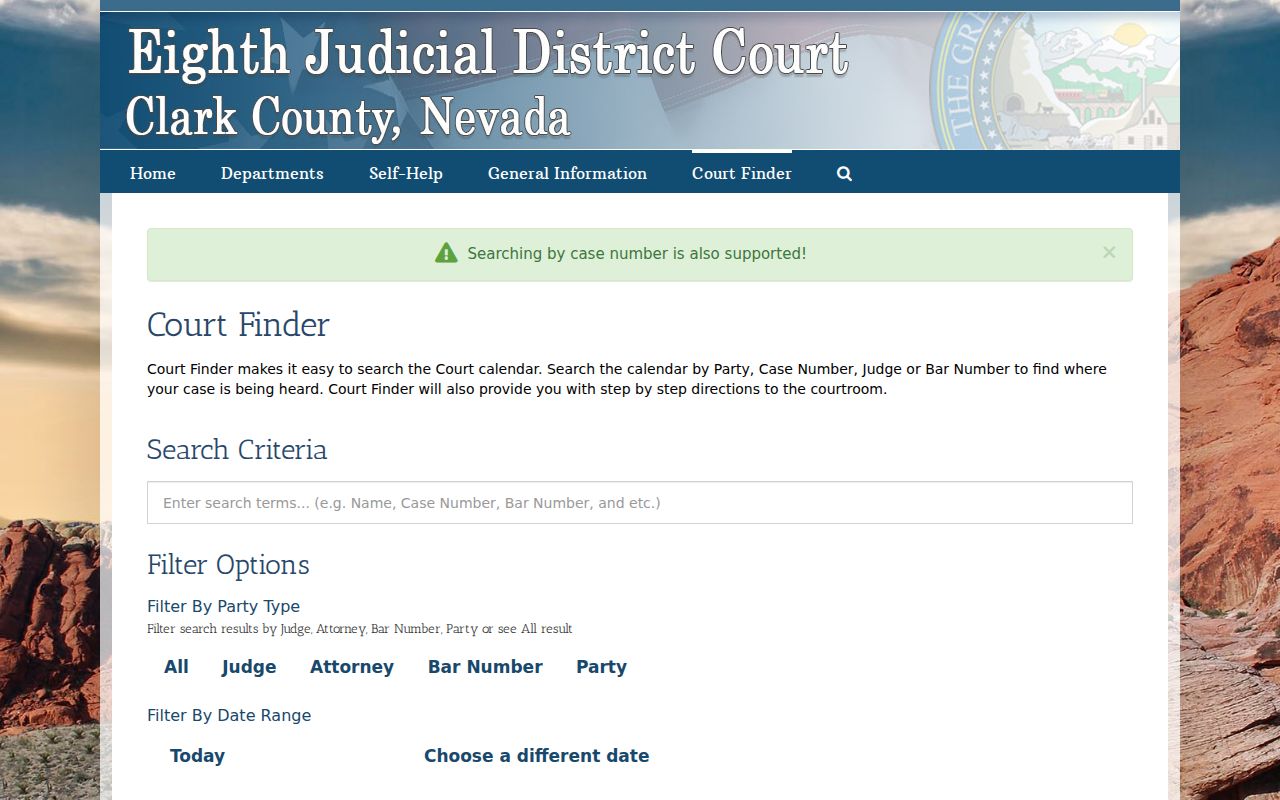
Use its result to find a case file or docket path, then read the docket itself; the search hit alone does not prove current identity or address. Note: The fee and age cutoffs come from researched Clark Clerk material; confirm them before requesting a file.
Nevada Appellate Records for One Name
ACIS, the Nevada Appellate Courts Public Portal, has participant and case searches. Participant search requires a last name; first and middle names narrow it, and organizations may appear as parties. A case search uses a case number or caption. Docket entries appear in filing order, and a document number may open a public PDF. Closed matters are excluded by default, so include them for an older case.
For a result, note case number and caption, court, filing date, status, disposition, party role, docket date, document number, and PDF access. Public documents may exclude appendices and sealed or confidential material. A docket proves a court link, not a home or current identity.
Open the official Nevada ACIS public portal for the party, case, and document paths shown in this capture.
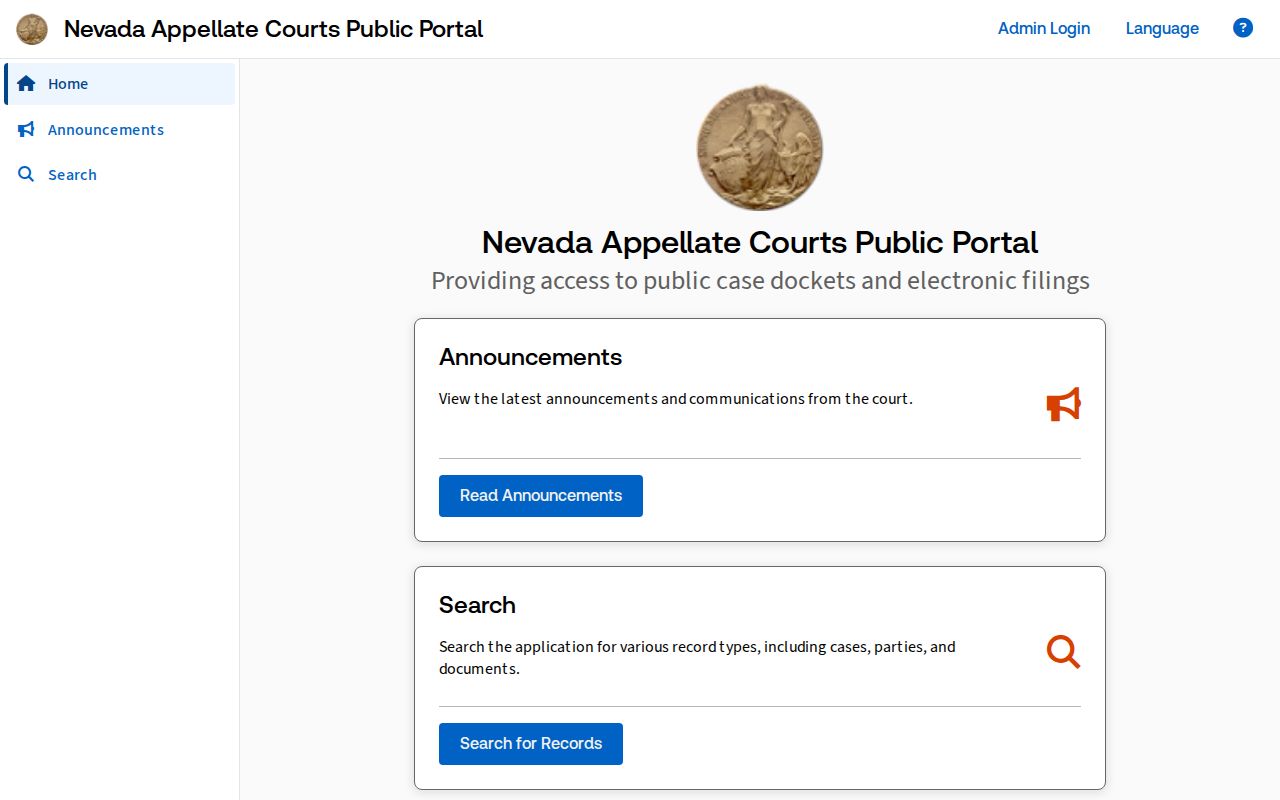
Use the portal's docket and document links to check what a case says, rather than treating the name in a result list as a full identity match.
Verify a Nevada Resident Across Records
Build a one-person chain from a known county, old address, case date, or middle initial. Keep each source's spelling and date. A name plus county is not enough: Nevada court, parcel, and vital indexes use different keys. Link results only after two independent details agree.
Move from a broad name toward records with narrower context:
| Official search route | Fields to keep with the result |
|---|---|
| Clark County Assessor search forms | Owner: required last name or company; optional first name, phonetic option, current or present/prior owner. Site address: numeric street number, direction, required street name, type, legal City/Town, phonetic option, and current or prior-owner choice. |
| Nevada Secretary of State entity search | Entity name, phonetic option, relevance sorting, Nevada Business ID, status, type, action, and filing route; labels may change during ORION transition |
- Save name variants, place, and date span; a partial match proves little.
- Search ACIS or the county court; note mode, case number, party role, and date.
- For an address, use assessor then recorder. Ownership does not prove occupancy.
- Check a distinct source, such as a dated directory or eligible vital request.
- Ask the custodian for a file or certified copy; omit unneeded identifiers.
Log the public result fields below, not a profile of the person.
- Case number, caption, and court.
- Party name and role, filing and docket dates.
- Status, disposition, document number, and PDF access.
- Docket
- A dated list of court actions, not the whole file.
- Index and image
- An index points to a record; an image is its scan. Some entries have no online image.
- Certified copy
- A copy the custodian certifies as official, unlike a search result or plain scan.
A dated Nevada city directory can add an older address, but needs corroboration. For the full street chain, use the street directory. Note: A negative search should name its source, query, date, filters, and known coverage limits.
Nevada Voter Records and Their Limits
Under NRS Chapter 293, county clerks hold registration books. Registration location is confidential; Social Security, driver or ID numbers, and registration email are not ordinary public fields. Voters may request address or phone suppression. Other fields may be public unless another law protects them.
The Nevada DMV voter-registration page routes registration and status updates to the Secretary of State and uses a state driver-license or ID. The research found no stable public result URL or field set, so do not promise a name-only search. Party choice is not legally public, and automatic-registration data has a restricted election purpose. The assigned capture shows the official voter route.
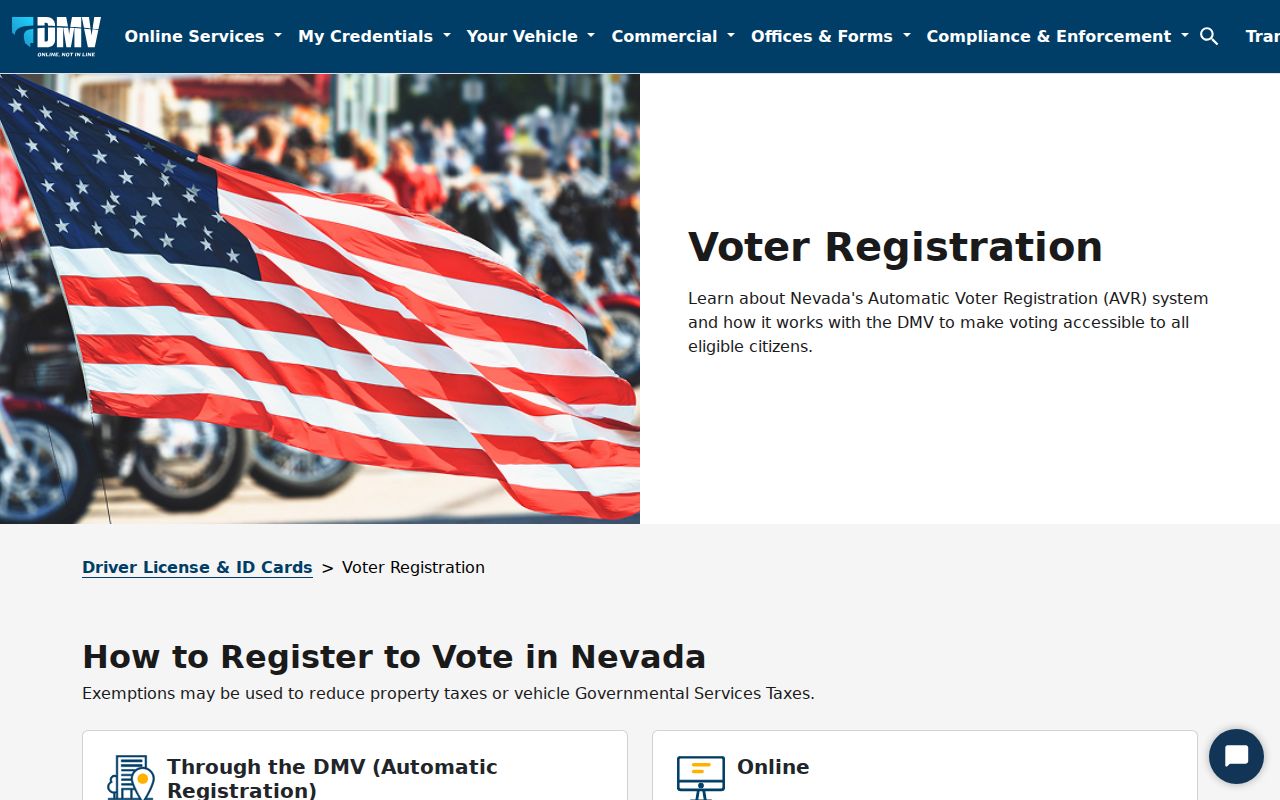
For a county-file request, ask the clerk what public list exists and how suppressed fields are handled; form and fee may vary.
Nevada Vital Records Require a Request
Birth and death certificates are qualified-access records, not public name indexes. Nevada's Office of Vital Records keeps certificates from July 1, 1911 onward. Forms request event details, parent names where relevant, applicant relationship or reason, signature, payment, photo ID, and proof of eligibility. Avoid copying sensitive fields when a simple confirmation is enough.
The researched schedule lists a certified birth copy at $25 and birth verification or a paternity letter at $10. Death copies are $25 for Carson, Clark, Douglas, Lyon, Mineral, and Washoe, $22 for other counties, and $10 for verification. Proof is required. Marriage and divorce copies come from the county where the event occurred.
For family history, use the Nevada forms and fee page. The Carson City office is at 4150 Technology Way, Suite 104; call 775-684-4242 to confirm hours and appointment details. Mail, walk-in, and online ordering routes are listed, and vendor fees can change.
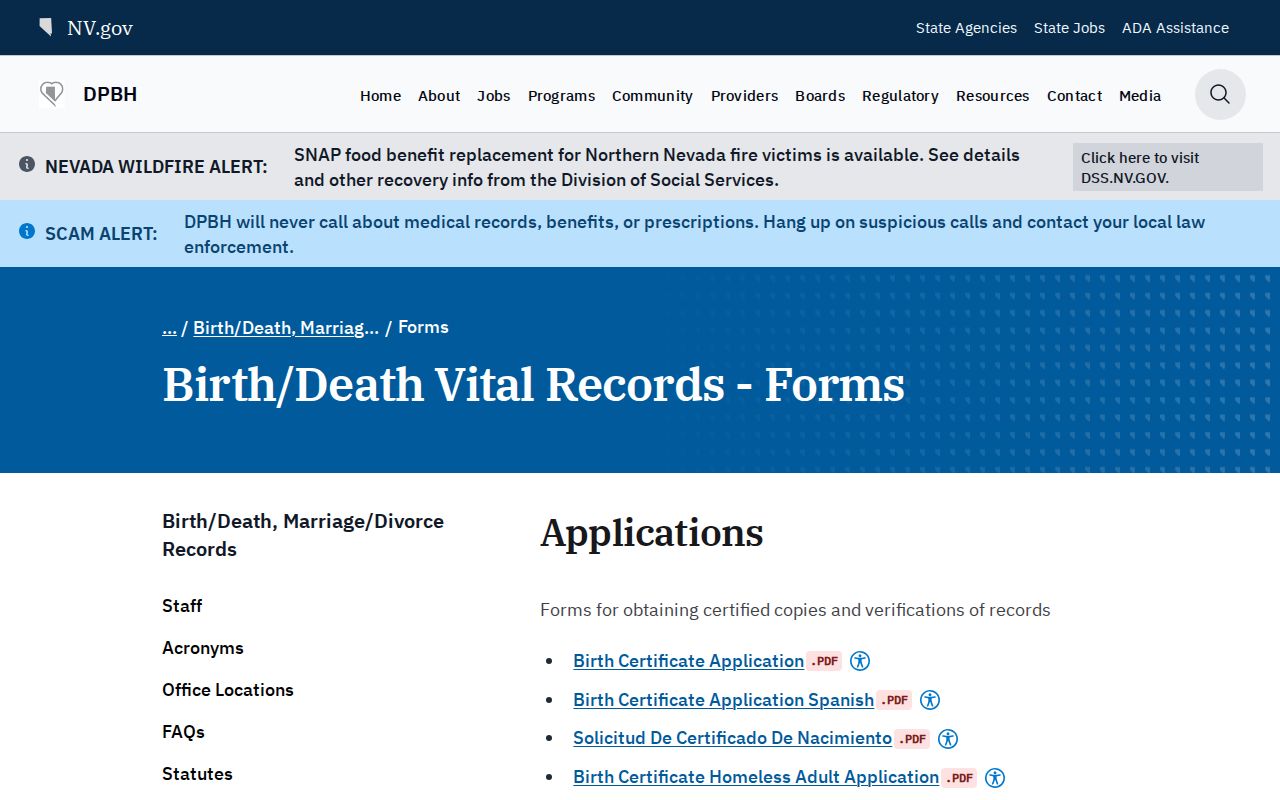
The image shows a request pathway, not a browse screen. Carson City describes genealogy appointments at $10 per name or variant per 30 minutes. The release period and full appointment rules were not verified, so confirm eligibility and arrangements before visiting.
Nevada Custody Searches Answer Different Questions
Nevada Department of Corrections (NDOC) searches by Offender ID or first and last name. It accepts a percent sign wildcard and offers demographic, alias, booking, parole, and release downloads. The page calls the data raw and says to verify it; the result is not a full correctional file. Requests for case records follow a separate process.
Open the official NDOC Offender Search to see the ID and name routes captured here.
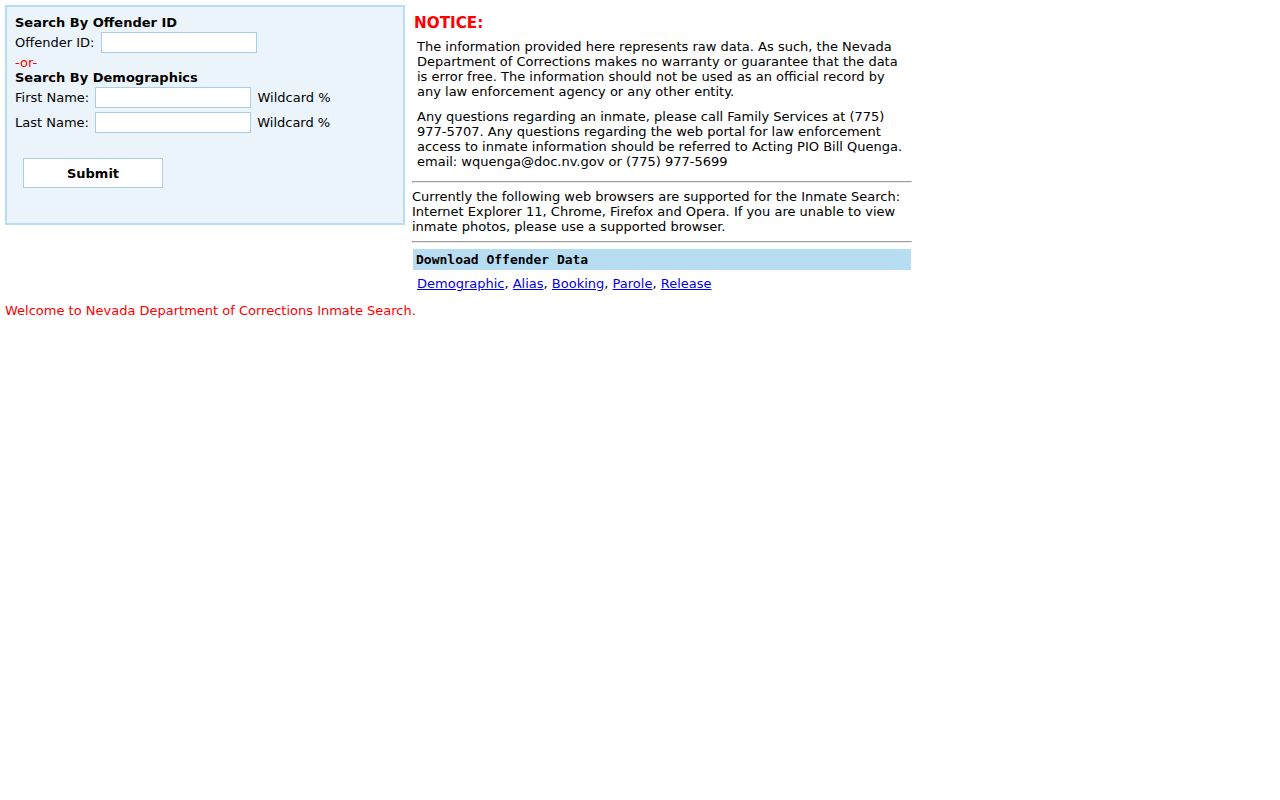
Use the display and its warning together, and do not publish extra personal details just because a field appears in a result.
Clark County Detention Center is separate and current-only; it accepts two letters of a last name, an inmate ID, or a Justice Court case number. Minors and people in protective custody may be omitted. Call 702-671-3900 with questions; this is not a statewide jail roster.
Nevada Registry Results Need Verification
The Nevada public offender registry has search paths by name, address radius, and Nevada ZIP, but only certain statutory tiers appear in public results. A positive match is not guaranteed to identify the person a searcher has in mind, and a non-result does not prove that no record exists. The portal's conditions of use prohibit harmful or harassing use; keep that caution next to any result and verify through the listed law-enforcement or court source when appropriate.
Read the Nevada registry terms and search notice before using the public search; those terms govern what the display can establish.
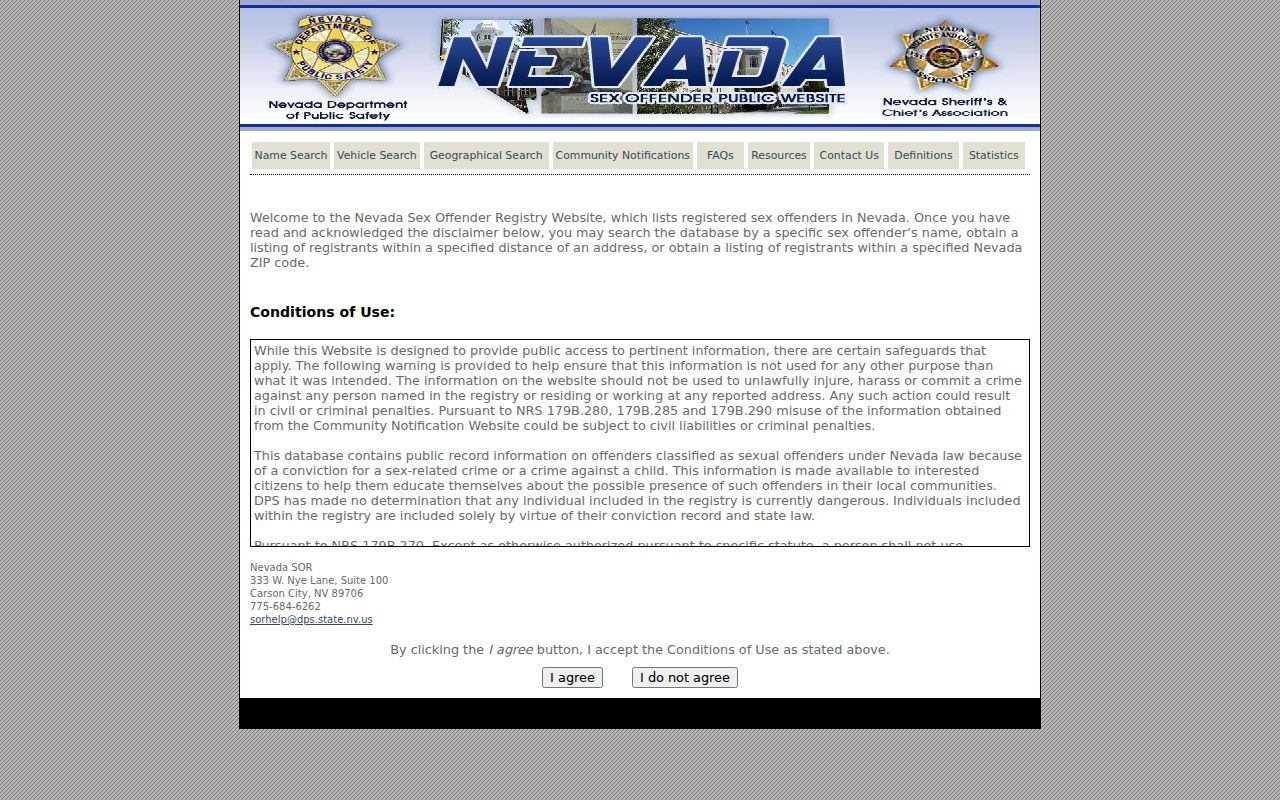
Record the search type, terms, date, displayed tier, and disclaimer, but avoid reposting unnecessary person-level details.
Nevada License Records Show Public Roles
A license or business filing can confirm a public credential or organizational role, not a private home. Nevada Real Estate Division's lookup accepts a name or license number and can display the license number, type, status, issue or expiration details, and public documents where available. Board portals differ, so name the issuing agency and retain the source date. Do not substitute a public business address for a residential address.
The Nevada Real Estate Division license lookup is shown in this capture as a name or number verification route.
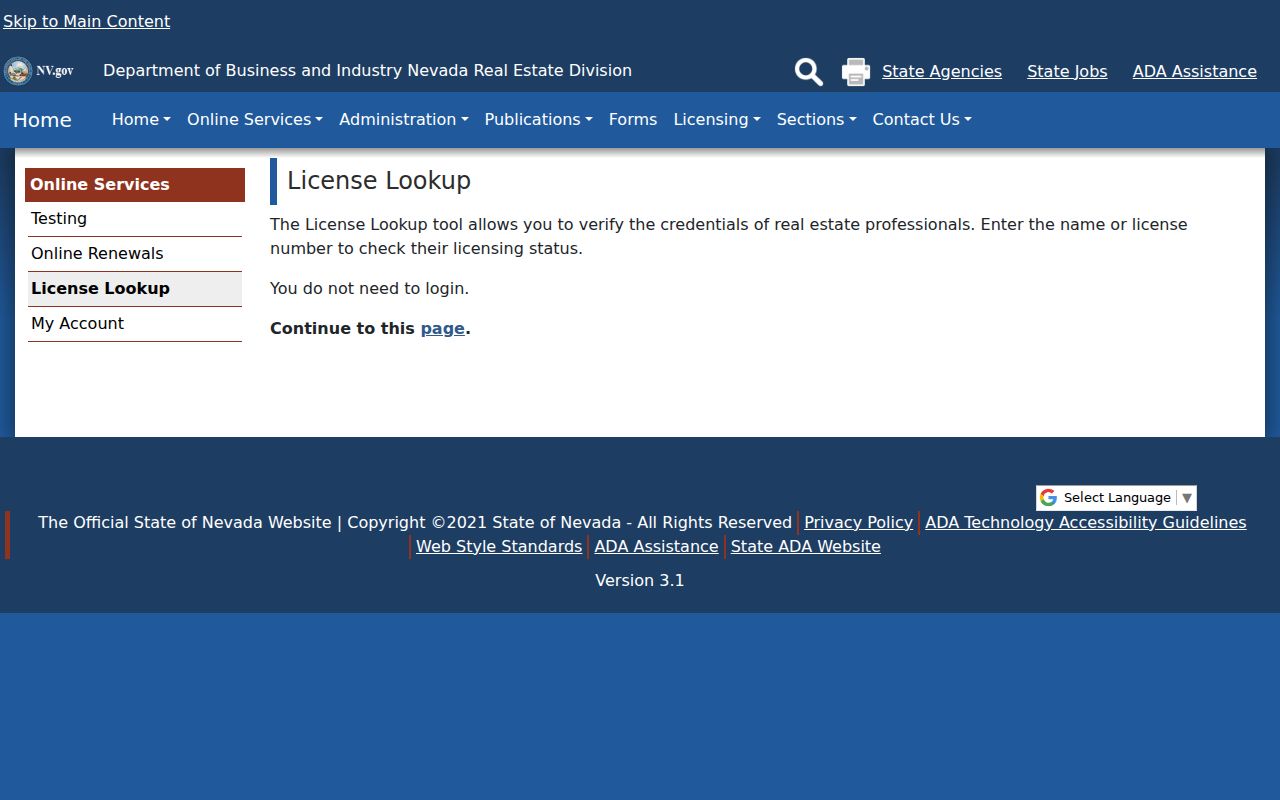
For a business link, the Secretary of State entity search shows a name, Nevada Business ID, status, type, and action; a trade name may need a county record. Project ORION was changing services in 2026, so check current labels in the linked search table above.
Privacy Limits on a Nevada Resident Lookup
When an online search fails, ask the custodian for an existing record. Nevada has no central desk for trial-court, county, city, voter, or vital files. Under NRS 239.0107, an agency must respond by the fifth business day. Name the file, office, county, date span, and known case or parcel key. An office need not create a new list or join databases.
Nevada's Confidential Address Program gives qualifying survivors a substitute address and mail forwarding. Its contact moved to the Department of Child and Family Services; check the current program page. Never try to turn a substitute address into a home address. A public-record request does not override voter, vital, sealed-court, or victim-confidentiality rules.
NRS Chapter 603A gives people a verified opt-out request for certain information held by covered operators and data brokers. The usual response window is 60 days, with an allowed extension. It does not erase a deed, court entry, assessor file, or archive item. See the Nevada privacy provisions.
Lawful use. Use Nevada records for a lawful personal purpose, and do not combine them to watch, threaten, stalk, or expose a protected person. Nevada law penalizes harassment and stalking; stop if a person or source has set a clear boundary.