
Start With a Nevada Name or Address
Nevada has no single roll that lists every resident. The right first search depends on what is already known. A name can lead to a court party index or a professional license record. An address points first to a county assessor, where a parcel number and legal description can steady later searches. A past household may call for a dated directory, a newspaper notice, or a deed recorded under an older description. These records answer separate questions, so one result should not be stretched into a claim about current residence.
For a focused Nevada residents directory search, keep the original spelling and record the query date, filters, county, and result type. Then move from the first record to a second source that can test the same identity or place. A result may show an owner, party, voter status, business role, or historical listing. None of those roles means the same thing. The Nevada residents directory is a route to separate record keepers, not a single statewide file.
- Set the place. Identify the county and, where relevant, the legal city or town. A postal city alone may point to the wrong local custodian.
- Stabilize an address with the assessor parcel number, or APN, and keep the legal description beside the street form.
- Search the office that keeps the record: assessor for assessment data, recorder for instruments, court for case activity, or clerk for county-held records.
- For an older search, use the library or archive collection that covers the place and year. Check the volume itself for its index rules.
- Compare two independent details before joining records, then note any gap, closed file, or result that could not be verified.
Where Nevada Keeps Its Records
Nevada’s public records are spread across state, county, court, and city offices. The State Library and Archives preserve deposited records and finding aids, while each county’s assessor, recorder, clerk, and elections office keeps its own records. Carson City is an independent consolidated city-county. There is no statewide deed index or single public county-clerk database, so the county where an event or parcel sits matters.
The Nevada Public Records Act, NRS Chapter 239, is the starting point for requesting an existing public record. It does not make every record open, create a custom list, or override a confidentiality law. Address-keyed records follow a separate chain, covered in the Nevada street directory.
Nevada State Archives
Archival finding aids and deposited state and local records.
Nevada Vital Records Office
4150 Technology Way, Suite 104
Carson City, NV 89706
775-684-4242
Nevada Elections Division
County clerk or elections office
One office serves each county
Custody is county-specific
Keep the APN With the Nevada Address
An address in Nevada can carry more than one place label. Clark County’s glossary distinguishes the location address, which points to the parcel, from the mailing address used for tax bills. The legal city or town field follows boundaries and may not match a postal city. Save all three values, along with the APN and legal description, before moving between an assessor, a recorder, or a historical source.
Clark County’s assessor warns that APNs can appear in old and new formats. A changed number does not by itself prove a sale or alter the legal description. The assessor says more than 90 percent of parcels had received new numbers by December 1996. That local change can explain why an older instrument is hard to find with a current parcel number.
- APN
- The assessor parcel number used to identify a tax parcel.
- Legal description
- The land description in an instrument, such as a subdivision, lot, block, or township and range.
- Situs or location address
- The physical address assigned to locate a parcel. It can differ from the mailing address.
- Index
- A search aid that points to a record. It may not include the full document image.
Clark Assessor Search Paths
The Clark County Assessor entry page brings several property routes together. It links to real property, manufactured homes, business personal property, maps, parcel maps, building sketches, and recorded-document tools. Its owner form asks for a last name or company; a first name is optional. Searchers can choose a phonetic match and select current parcel or present and prior owners.
The Clark Assessor real-property search landing page shows those starting points. It is one county example, not a Nevada-wide owner database.
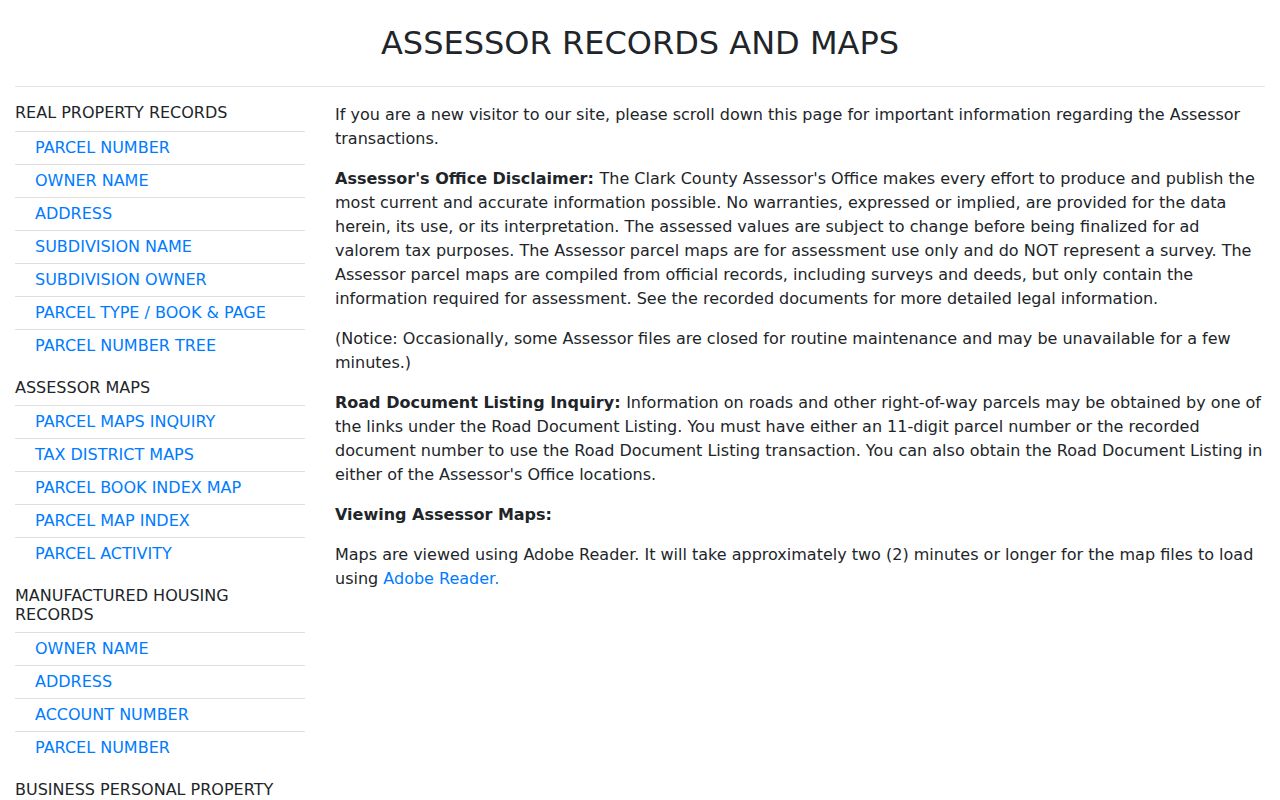
The route matters: a parcel result describes assessment data, while a recorder image shows an instrument. Follow each link to its own custodian and note the date.
| Clark search field | What to enter | What to preserve |
|---|---|---|
| Owner | Last name or company; first name optional | Phonetic setting and current or present/prior owner mode |
| Site address | Street number and required street name | Direction, type, legal city/town, and phonetic choice |
| Parcel or map | APN, map, or book/page route | APN format, legal description, and linked document |
| Other property routes | Subdivision, building sketch, road or recorded-document path | Exact route and the source date shown |
Requesting Nevada Records Under NRS 239
Nevada’s public-records law sets a response clock, not a promise that every requested item is public or ready at once. Under NRS 239.0107, an agency must respond by the end of the fifth business day. If it cannot produce the record then, it must provide the required written status or estimate. NRS 239.052 allows actual-cost fees in the circumstances the statute describes; each agency’s copy schedule can differ.
Ask the office that keeps the record. State the record type, county, name or address, APN if known, date range, and whether inspection or a copy is wanted. Request existing fields or documents rather than asking an office to build a new directory or decide what the records mean. Keep the request, acknowledgment, and any estimate together.
Note: State and local offices handle their own records, so a request sent to the wrong custodian may need to be rerouted.
Current Nevada Records by Question
Modern public records are partial lists with different purposes. A property roll connects an owner to an assessed parcel. The voter route lets an eligible registrant check or update personal status, while public voter-list material is handled through county election offices under NRS Chapter 293. Court and professional-license results document a public record or role, not a complete residential list.
| Record source | What it can show | Custodian | Access route |
|---|---|---|---|
| Assessor roll | Owner shown for assessment and tax billing | County assessor | County-specific search portal or office |
| Recorded instruments | Named parties, document type, parcel description | County recorder | County index, image, or records request |
| Voter registration | Individual status and public-list fields permitted by law | County clerk or elections office | DMV/SOS status route; public-file request by county |
| Court docket | Case parties, filings, dates, and public documents | Relevant court clerk | ACIS for appellate matters; separate trial-court portals |
| Professional license | License status and public role fields | Issuing state board | Board-specific search or request |
Use the assessor for a parcel owner, the recorder for a signed and recorded instrument, and the court portal for a case. The Nevada DMV voter-registration page points to the Secretary of State status and update service, which uses a Nevada driver license or ID. It is not a public browse-by-name directory. The county voter file is a different access route with protected fields. These sources shape a practical Nevada residents directory by showing their specific record types, not every person in a community.
Nevada Birth and Death Records Need Proof
The Nevada Office of Vital Records is the legal custodian of birth and death certificates from July 1, 1911 to the present. These are request records, not a public search index. The application asks for identifying details about the event and applicant, the relationship or legal reason, a signature, payment, photo ID, and proof of qualification. A form or online vendor does not remove those access rules.
The state lists a certified birth copy at $25 and a verification at $10. In the inspected death-fee schedule, copies were $25 for Carson, Clark, Douglas, Lyon, Mineral, and Washoe counties, and $22 for other Nevada counties. Verification is listed at $10. Fees and vendor charges can change, so check the current form before sending payment.
Marriage and divorce copies are generally routed to the county where the event occurred. FamilySearch can help identify a county and date, but its index or image is not a certified county copy. Pre-1911 vital records may be county-held, and the official sources inspected did not establish a single unrestricted genealogy release period.
Nevada Civic Groups Mark Local Boundaries
Neighborhood programs can explain the civic shape of a Nevada place, but they are not resident lists. The City of Las Vegas neighborhood-association page describes registration, local boundaries, and resources. Its rules say registration is free, the group must be inside city limits, meetings must be open to residents, and its board must include a president, vice-president, and secretary. The page did not expose a complete association-name export.
Reno’s Neighborhood Advisory Boards offer ward-based meetings, notices, and public participation. They are advisory groups, not a roll of who lives on each block. The inspected master-plan material describes five wards, but current maps should be checked before using a ward label. Meeting packets and agendas can add local context when matched with the right date and place.
Nevada Court Searches Need a County
The Nevada Appellate Courts Public Portal, known as ACIS, is the centralized starting point for appellate cases. It supports case number or case name and a participant search that requires a last name, with first and middle names available to narrow results. Docket entries appear in filing order, and a public document number may open a PDF. Closed cases are excluded by default in the described workflow; sealed and confidential materials remain unavailable online.
Trial records are separate. Clark CourtFinder searches by party, case number, judge, or bar number, with a date range limited to 30 days in the inspected interface. Clark court coverage includes civil, criminal, probate, family, and child-support matters. Other district, justice, and municipal courts use their own portals or clerk routes. A name not found in one system is not a statewide negative result.
A docket can confirm that a name appears in a case, but it does not establish a current address or identity by itself. Compare the case date, role, court, and at least one independent detail before treating a same-name result as relevant.
Nevada Libraries Hold Older Name Trails
Current portals do not replace Nevada’s library and archive collections. UNR Digital Special Collections is a strong starting point for Reno, Sparks, and nearby city directories that begin around 1900. UNLV’s microform catalog identifies Nevada Territory directories from 1861 to 1882 and describes residents, occupations, heads of families, business listings, street directories, organizations, and advertisements. Some material needs a reading-room visit or staff help.
The Las Vegas-Clark County Library District genealogy resources link to newspaper and local-history material, genealogy databases, city and telephone directories, and a card-file index to Las Vegas Sun and Review-Journal coverage from 1970 to 1982. A notice or directory entry is a dated lead, not proof that every member of a household lived at one address.
For the full collection runs, publisher notes, and method for comparing annual entries, use the Nevada city directory collections.
Nevada ZIPs, ZCTAs, and Legal Cities
A Nevada ZIP Code is a USPS delivery label, while a ZCTA is a Census statistical area built from census blocks. The two do not always match. Some delivery ZIPs, including PO-box-only or unique codes, may have no ZCTA. A ZCTA can also be generalized or noncontiguous. The 2026 Census Gazetteer lists 181 Nevada ZCTA identifiers; an older state guide listed 176, so a count needs a source year.
Use the USPS ZIP Code Lookup to confirm delivery city and ZIP for a specific address. Use the Census vintage when mapping or comparing statistical areas. A Nevada parcel’s legal city or county comes from local boundary and assessor data, not simply the ZIP label. These three geographic values should not be merged.
Nevada Results Carry Different Dates
Several Nevada records can look current while describing different time frames. The Nevada DOT statewide parcel layer is identified as 2018 county-supplied data. Local assessor maps can have newer refresh dates. A city directory records its publication year, while a deed has both recording and event dates. The 2026 Census ZCTA file has its own vintage. Keep those dates alongside the result rather than comparing them as if they were one update cycle.
For a source that is missing online, follow its documented fallback. County recorder and clerk offices may provide an index, image, mail request, or counter service. Libraries and archives may hold microfilm, reels, finding aids, or material that needs an appointment. The State Library and Archives program page explains how to contact its staff, but a finding aid alone does not prove that a specific item is online or unrestricted.
Note: Record the portal, search terms, filters, and access date so a later reader can repeat the same search.
Trace Past Nevada Residents Through Archives
Nevada’s historical records may be filed under an earlier county, territorial office, mining district, town lot, or claim name. State Library and Archives guides describe Carson County and Utah/Nevada territorial material from 1851 to 1864, as well as records from Storey, Washoe, Lyon, Douglas, and Ormsby. A current street name may not appear in a deed or court index created before a later boundary or address change.
For one past household, compare two or more dated directory listings with deeds, a newspaper notice, or a map that identifies the building or lot. A directory can omit people, use initials, or rely on household-head conventions. A Sanborn map may show a structure, its use, materials, height, and lot lines, but it does not name the people inside. This cross-check is useful for family history and local research, while keeping a clear line between place evidence and person evidence.
When an online result stops, note the exact missing year or record series and ask the relevant library, archive, or county custodian about a reel, volume, or paper index. Nevada records have uneven digitization, and the access method can change from county to county.
Privacy and lawful use. Public information has limits. Do not use a record trail to stalk, harass, expose a protected address, or bypass a sealed or confidential record.