
Where Nevada City Directories Survive
Nevada has no single statewide directory or one complete online run. The strongest inspected Nevada paths are regional: UNR Libraries for Reno and Sparks, UNLV for southern Nevada and territorial material, and the Las Vegas-Clark County Library District for local-history holdings. A Nevada collection title can cover more than one kind of entry, so check whether a volume is residential, business, institutional, or a street-order list before using it. The table keeps Nevada year details separate from holdings whose full date range was not reported.
| Collection | Years | Where Held | Access |
|---|---|---|---|
| U.S. directories, including Nevada Territory | Territorial runs: 1861-1882 | UNLV microform catalog | Catalog and reel details; microform room or staff help may be needed |
| Reno, Sparks, and nearby volumes | Early runs begin around 1900; exact coverage varies | UNR Digital Special Collections | Browse digitized items; older material may be best used in the reading room |
| Las Vegas city and telephone directories | Year span not stated in the inspected record | Library District board minutes | Ask about local-history holdings and current access |
| Southern Nevada business directories | 1996-2001; rural-county and Washoe volumes around 2000 | UNLV Special Collections | Business reference, not a complete residential directory |
These Nevada collection boundaries are not a promise that every year survives or that every page is online. UNR describes its Reno and Sparks material as early runs beginning around 1900, while the UNLV catalog identifies a Nevada Territory span within a broader U.S. city-directory record. The inspected Nevada sources do not supply a complete statewide list of publishers, missing years, or last printed editions. Record the exact title and year printed inside the volume you use.
For older Nevada research, move from the catalog record to the item or reel. A library finding aid helps locate material; it does not show that a full run is searchable from home.
Nevada's Reno and Sparks Directories
UNR Libraries' Digital Special Collections is the strongest inspected online starting point for northern Nevada, including Reno, Sparks, and nearby communities. Its description of Nevada's early city-directory runs begins around 1900. That is a starting point, not a fixed end date: available Nevada years vary, and one missing or unindexed volume can break a name search. UNR's Nevada primary-source advice also warns that older items may have uneven searchability and are often better handled in person in the reading room.
For Nevada volumes, search by surname, given name or initial, street, business, and year. Before drawing a conclusion, open the title page and introductory matter. Note the publisher, edition, year, city or area, page, image location, and whether the line names a resident, firm, institution, or cross-reference. Compare more than one dated volume. A name that drops out may reflect a move, a spelling or initial change, a missing book, or non-listing; it does not by itself show when someone left Nevada.
Nevada Territorial City Directories
UNLV's microform catalog describes U.S. volumes with Nevada Territory runs from 1861-1882. The Nevada books can include residents, occupations, residences, heads of families, firms, public officers, street directories, organizations, banks, and advertisements. For Nevada readers, the mix matters: an entry may refer to a person, a business, or a civic body, and the section heading tells which one.
The UNLV microform record lists the reel and call-number details for Nevada directory material. Access may involve the microform room or help from library staff, so use the catalog to plan a visit rather than assuming each Nevada volume can be read online.
The catalog record for UNLV's Nevada microfilm shows where the territorial collection is described and how it is reached.
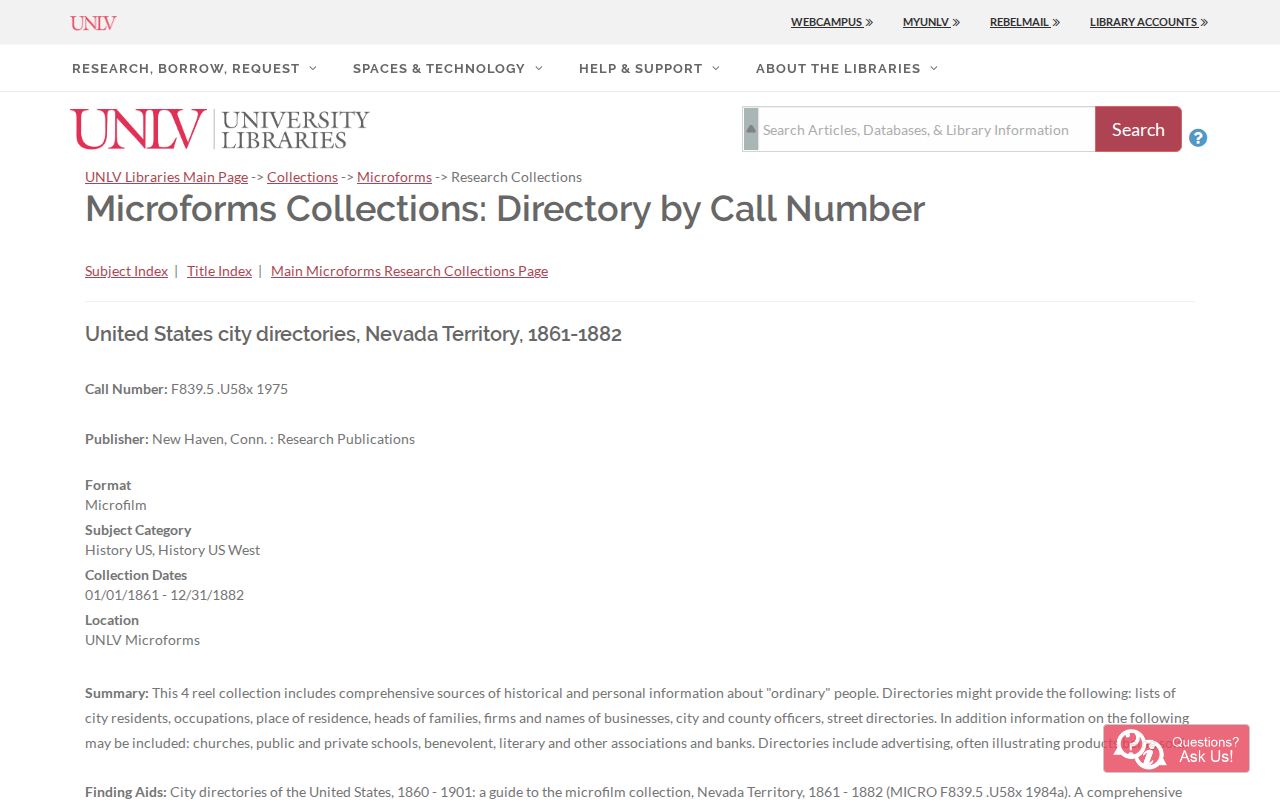
This image documents the catalog route. The reel itself remains the source to inspect for the title, year, page, and exact entry wording.
Reading Nevada's City Directory Entries
Nevada directory formats change by title, city, and year. For Nevada city volumes, UNLV's catalog confirms that its collection may include resident names, occupations, residences, and heads of families, but it does not give one field order for every book. Start with the Nevada volume's printed guide and section label, then copy the entry as it appears. A residential listing, a firm notice, and a public-officer list answer different questions.
| Name or household head | Resident names and heads of families are described in the UNLV catalog; exact order varies by volume. |
|---|---|
| Occupation | Listed as a possible directory field in the collection description; transcribe the printed wording. |
| Residence or street | Residence and street-directory sections are described; check the volume's own headings. |
| Spouse or family mark | Not verified in a Nevada residential sample inspected for this research; do not assume it appears. |
| Owner or renter mark | No statewide or collection-wide notation was confirmed; record a mark only when the volume defines it. |
- Criss-cross section
- A street-order section, when a volume has one, that lets a reader begin with an address rather than a surname.
- Householder index
- An index organized around household heads; check the volume's own title and rules before treating it as a complete household list.
- Abbreviation key
- The volume's guide to shortened words and symbols. Read it before expanding any mark in a transcription.
A scanned UNLV oral-history item includes a 1975 ConSurvey directory supplement sample. Its visible example is a business entry with a name, street address, and phone number. That confirms the format of that business supplement only; it is not a model for a Nevada residential entry. When a Nevada listing is unclear, keep the Nevada page citation and mark uncertain letters instead of filling them in from memory.
Nevada's Las Vegas History Holdings
The Las Vegas-Clark County Library District's local-history materials reach beyond a current city list. Nevada library board minutes identify newspaper clippings, city and telephone directories, and a card-file index to Las Vegas Sun and Review-Journal coverage from 1970-1982. The Nevada District's African American Special Collection adds local pamphlets, photographs, clippings, and community-heritage items. These sources can add a name or group that a general directory does not list.
The Nevada District's genealogy resources and African American Special Collection pages are entry points, not guarantees that each item is digitized. Access to discovery tools may depend on a library card, an in-library terminal, or a vendor account. Ask staff which Nevada title, year, or collection is available and keep that title with any search note.
UNLV's Las Vegas Chamber collection includes guides, directories, annual reports, organization contacts, and other institutional records across several decades. These describe groups and businesses; they are not a count of Nevada households.
Nevada Names in Papers and Maps
UNLV's Nevada Newspapers on Microfilm catalog reports more than 800 newspaper titles by city, county, or title. It points to a Review-Journal index covering 1930-1968 and a Las Vegas Age index for 1905-1940. A Nevada obituary, marriage notice, legal notice, or community item can help explain a directory change, but first identify the notice type, publication, date, page, and headline. A newspaper mention is a lead to compare with the directory, not a substitute for it.
UNLV's Nevada newspaper holdings describe the titles and local access routes. For Reno, Nevada, the Library of Congress has a Sanborn map item covering 1918 through December 1949, with 73 sheets. Nevada Sanborn maps show buildings, uses, materials, height, lot lines, roads, water features, and revisions. They help place an old address in Nevada's built landscape, but they do not name every person who lived there.
The Reno, Nevada, Sanborn collection item provides access to the map sheets and their dates. Match a Nevada sheet to the street and edition before using it to interpret a directory address.
Nevada City Names and Directory Areas
In Nevada, a place name does not always tell you which government kept a record. “Las Vegas” can mean the City of Las Vegas, unincorporated Clark County, or a postal city. The Clark County Assessor glossary distinguishes a legal city or town from a mailing address. A Nevada directory's city label describes its publication area; it does not settle a parcel's jurisdiction or prove that every person in the postal area appears in the book.
This Nevada geography matters when an older family record points to a town that later changed boundaries or names. Search the city and county named in the dated source, then keep the printed address and legal jurisdiction as separate notes. The coverage table gives the different northern and southern Nevada collection routes.
Nevada City Pages Aren't Archives
Current Nevada city pages can supply civic context, but they are not historical resident indexes. Nevada city sites may publish staff contacts, boards and commissions, meeting agendas, public comments, permits, or neighborhood program details. The City of Las Vegas, Nevada, association page is a current contact path, while Reno's Neighborhood Advisory Boards are ward-based advisory groups. Neither source is a roster of everyone living in a neighborhood.
For older Nevada material, look for the dated packet, minutes, newspaper, directory, library file, or archival series that holds the record. A Nevada public-record request can ask a city for an existing, identifiable record; the agency does not have to create a new directory of people. If a historical listing needs a modern check, the Nevada resident lookup page describes how to compare a name across current record sources without treating one match as proof.
For Nevada civic contacts, use Las Vegas neighborhood resources or Reno's engagement and advisory-board page. For records held by Nevada State Library and Archives, start with its Nevada archival collections guide; a finding aid identifies a series but does not mean every item is open or online.
Trace Nevada Families Through Directories
A Nevada name search works best when each source is treated as a dated snapshot. Start with the Nevada city and the year that family stories point to. Read the volume's introduction and abbreviation key, then note the exact name, address, page, publisher, and item image. Search the next available Nevada volume for spelling and initial changes. If the Nevada directory has a street section, use it to test an address, not to assume who lived there throughout the year.
- Choose the city, volume year, and name form; check initials and alternate spellings.
- Copy the full listing and its page or image reference, along with the volume title and publisher.
- Compare nearby directory years and a census year relevant to the period. The Nevada source set did not inventory census schedules or access routes, so confirm holdings with the library before treating a gap as meaningful.
- Use a newspaper index or a relevant family record to test a move, marriage, or death lead.
- Keep a separate note for every source, including whether it is an index, a scan, or an official record.
FamilySearch's Nevada County Marriages collection covers 1862-1993, but Nevada county coverage varies and some images have limits. Use a Nevada match to identify a county, date, or relationship to check, then seek an official copy from the county clerk that holds the marriage record. The image below is the Nevada discovery collection's landing page.
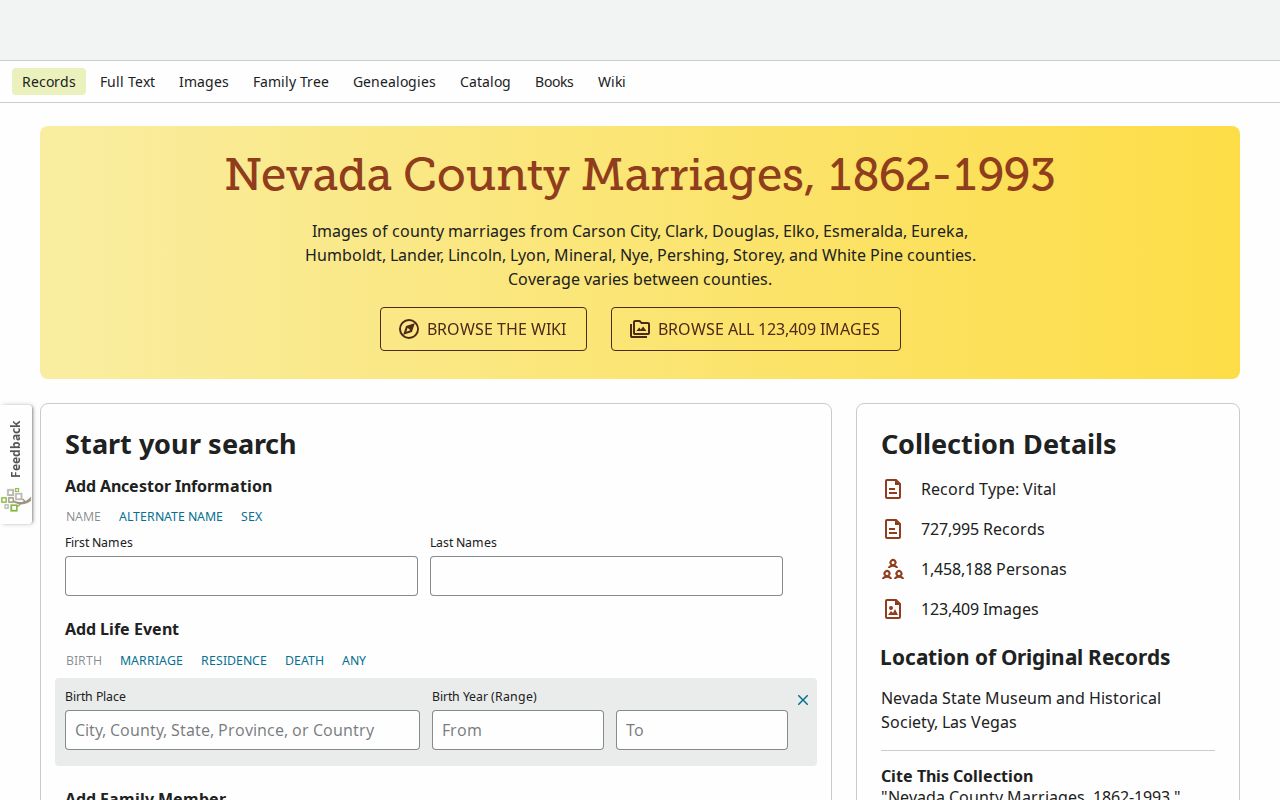
This collection can help connect a name to an event, but it does not fill gaps in the directory years or prove an address by itself.